The Miracle of Regathering

The Jewish prophet Ezekiel wrote of the future return of his people to their ancestral homeland 2500 years ago. It is a true miracle that the Jewish people who have suffered exile, persecution, forced assimilation and near annihilation have not only survived, but regathered into their eternal homeland. This blog is intended to stir hearts and minds to contemplate the importance of this modern miracle and to generate dialogue about current cultural, geopolitical and spiritual issues that impact us ALL.

Wednesday, January 23, 2013

Democracy: The Real Winner in Israel's Election

A few observations about the Israeli election results:
lapid
Yair Lapid

Right-left split changes, but not a game changer: From an outsider's perspective, Israel would seem to be a very politically unstable place. The biggest party in the previous Knesset, Kadima, crashed from 28 seats to two. The No. 3 party, Yisrael Beiteinu, hitched its wagon to the ruling party, Likud, but their combined list lost about a quarter of its seats, down to 31 from 42. Meanwhile, a party that didn't exist until a few months ago, Yesh Atid, emerged as the 120-seat Knesset's second largest with 19 seats.

Yet despite the swapping of party labels, not much has changed in the right-left power split. Yes, the right wing lost a little ground -- from 65 seats in the last Knesset to 60 seats in the new one. But within the rightists' camp, votes moved rightward from the more moderate Likud to the Jewish Home party. 

Also, it would be a mistake to lump together all the centist and left-wing parties. The biggest winner of the center, Yesh Atid, espouses positions on Palestinian-related issues that in many respects are not dissimilar to Likud's: Both favor negotiations with the Palestinians (though skeptics say Likud's position is more rhetorical than genuine) and retaining the large Jewish settlement blocs in the West Bank while opposing any division of Jerusalem. Most notably, Yesh Atid leader Yair Lapid has made clear that he wants to join a coalition with Likud, which is led by Prime Minister Benjamin Netanyahu.

Even if centrist parties such as Yesh Atid are massed with the leftists, they constitute a minority of fewer than 50 seats; the balance goes to the Arab parties.

New priorities: With Israelis deeply pessimistic about the chances for imminent peace, a significant number of voters went for parties that made socioeconomic issues, not security, the centerpiece of their campaigns. Yesh Atid ran a campaign about social and economic issues, and Labor leader Shelly Yachimovich, who led the party to 15 seats, up from eight in the last Knesset, virtually ignored security issues in her campaign. This represents a sea change from the old days, when campaigns were all about security. Tzipi Livni's Hatnua bucked the trend, emphasizing peace with the Palestinians. The result: six seats.

New faces: The 19th Knesset will see a plethora of new members, with more than a quarter of the parliament occupied by first-timers, most of them from Jewish Home and Yesh Atid. Jewish Home is led by a son of American immigrants to Israel, businessman-turned-politician Naftali Bennett, and Yesh Atid is guided by Lapid, a former TV personality and the son of the late politician Yosef "Tommy" Lapid.

Women: The new Knesset will have more women; Yesh Atid leads the way with eight female representatives. The Likud-Beiteinu list has seven, Labor has four, Meretz has three and Jewish Home has two. Hatnua and Hadash each has one. Among the newcomers will be the body's first Ethiopian-Israeli woman, Penina Tamnu-Shata of Yesh Atid, an attorney who immigrated to Israel at age 3 during Operation Moses.

The end of Kadima: Twice in its short history, the Kadima leader occupied the prime minister's office. But in just one election cycle, the party went from Israel's largest faction to just two seats. Various factors doomed Kadima: the rise of Yesh Atid, whose socioeconomic-focused platform and charismatic leader peeled away centrist voters; Livni's failure to gain adherents for Kadima and subsequent defection to her new party, Hatnua; and Shaul Mofaz's decision to join, albeit briefly, the Likud-led ruling coalition. It's not the end of centrist politics in Israel, but it appears to be nearly the end of the road for the party started by Ariel Sharon as a breakaway from Likud.

Bibi weakened: Netanyahu supporters used to herald him as Bibi, King of Israel. So did Time magazine just a few months ago. But with the combined Likud-Yisrael Beiteinu list falling by a quarter after what was widely panned as a lackluster campaign, it's difficult to make the case that Netanyahu's star is burning brighter. He's almost sure to capture the premiership again -- now comes the horse trading that is Israeli coalition building -- but it seems it will be more for lack of an alternative than enthusiasm for Netanyahu.

Hello, Naftali Bennett: If there was any enthusiasm on the right wing this time, it appeared to be for Naftali Bennett, leader of the newly constituted Jewish Home party (itself a successor to the National Religious Party). The party captured 11 seats, up from just three as the NRP in the last Knesset. Bennett, who supports annexation of parts of the West Bank, is likely to apply pressure on Netanyahu to shift further right on security issues.


Follow Virtual Jerusalem on  and 

Israel Beware: Demagoguery Has Been Sworn In For A Second Term

Daniel Pipes, president of The Middle East Forum recently wrote an article in the Washington Times that succinctly summarizes the anticipated direction that this US administration will move now that President Obama has officially taken the reigns again for a second term:

"The election is over, President Obama has just been sworn in for a second term, and cold treatment of Israel is already firmly in place. Mr. Obama has signaled during the past two months what lies ahead for U.S. relations with Israel through several actions.

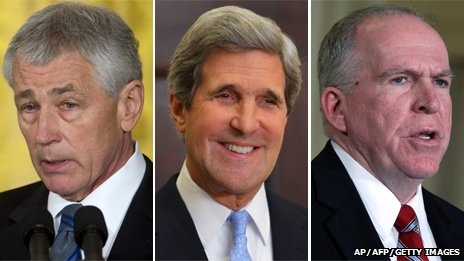
First, he chose three senior figures — John Kerry for the State Department, John Brennan for the CIA and Chuck Hagel for the Defense Department — who range from clueless to hostile about Israel.


He also approved a huge gift of advanced weapons — 20 F-16 fighter jets and 200 M1A1 Abrams tanks — to the Islamist government in Egypt. This is despite Egyptian President Mohammed Morsi, who calls Jews “blood-suckers warmongers, the descendants of apes and pigs,” becoming increasingly despotic.

Reiterating the patronizing, 35-year-old tactic relied upon by anti-Israel types to condemn Israeli policies while pretending to be concerned for the country’s welfare, Mr. Obama said: “Israel doesn’t know what its own best interests are.”

He ignored evidence of Cairo importing Scud missile parts from North Korea. He rebuffed the 239 House members who called for closing the Palestinian Liberation Organization office in Washington in response to the Organization’s drive for state-observer status at the United Nations.
Asked about Mr. Obama’s nomination of Mr. Hagel, Ed Koch, the former New York City mayor who, despite his astringent criticism of Mr. Obama, nonetheless endorsed him for re-election, offered an astonishing response: “I thought that there would come a time when [Mr. Obama] would renege on his support of Israel, [but this] comes a little earlier than I thought.” Even Mr. Obama’s pro-Israel supporters expected him to turn against the Jewish state.

These anti-Israel steps raise worries because they jibe with Mr. Obama’s early anti-Israel views. We lack specifics, but we know that he studied with, befriended, socialized with and encouraged Palestinian extremists.

For example, a picture from 1998 shows him listening reverentially to anti-Israel theorist Edward Said. Mr. Obama sat idly by as speakers at an event in 2003 celebrating Rashid Khalidi, a former Palestinian Liberation Organization public relations operative, accused Israel of waging a terrorist campaign against Palestinians and compared “Zionist settlers on the West Bank” to Osama bin Laden. Ali Abunimah, an anti-Israel agitator, commended Mr. Obama in 2004 for “his call for an even-handed approach to the Palestinian-Israeli conflict,” code words for distancing the U.S. government from Israel. In turn, Mr. Obama praised Mr. Abunimah for his obsessively anti-Israel articles in the Chicago Tribune, urging him to “keep up the good work.”

Mr. Abunimah also reveals that, starting in 2002, Mr. Obama toned down his anti-Israel rhetoric “as he planned his move from small-time Illinois politics to the national scene.” Mr. Obama made this explicit two years later, apologizing to Mr. Abunimah: “Hey, I’m sorry I haven’t said more about Palestine right now, but we are in a tough primary race. I’m hoping when things calm down I can be more up-front.”

Mr. Obama dutifully made the requisite policy changes, if in a cramped and reluctant manner. (“I have to deal with him every day” he whined about Israeli Prime Minister Benjamin Netanyahu.) He supported Israel in its 2008-09 and 2012 wars with Hamas. His administration called the Goldstone Report “deeply flawed” and backed Israel at the United Nations with lobbying efforts, votes and vetoes. Armaments flowed. The Israeli exception to the Nuclear Non-Proliferation Treaty remained in place. When Ankara canceled Israeli participation in the 2009 “Anatolian Eagle” air force exercise, the U.S. government pulled out in solidarity. If Mr. Obama created crises over Israeli housing starts, he eventually allowed these to simmer down.

Returning to the present: Mr. Netanyahu’s likely re-election on Tuesday as Israeli prime minister will mean continuity of leadership in both countries. This does not imply continuity in U.S.-Israel relations, however. Mr. Obama, freed from re-election constraints, can finally express his early anti-Israel views after a decade of political positioning. Watch for a markedly worse tone from the second Obama administration toward the third Netanyahu government.

Recall what Mr. Obama said privately in March 2012 to then-Russian President Dmitry Medvedev: “This is my last election and after my election, I have more flexibility.” There is every reason to think that having won that re-election, things have now “calmed down” and, after a decade of caution, he can “be more up-front” to advance the Palestinian cause against Israel.
Mr. Obama has won his second term, and Israel’s troubles have really begun. Jerusalem, brace for a rough four years."

Daniel Pipes (DanielPipes.org) is president of the Middle East Forum.


Read more: http://www.washingtontimes.com/news/2013/jan/22/obama-second-term-bodes-trouble-for-israel/#ixzz2IovIr516
Follow us: @washtimes on Twitter

Wednesday, November 28, 2012

The Illusion of Moderation and The Farce of Palestinian Statehood

Nabil Sha'ath, a senior member of Fatah, was once the chief "peace negotiator" for the PLO.  He was not negotiating on behalf of Hamas - the avowed extremist anti-Zionist terror organization that controls Gaza, but their supposed moderate rivals in the power struggle over control of "Palestine," the PLO - now known as the Palestinian Authority.

Sha'ath is well known himself to be stoutly anti-Israel and hence is no longer a part of the negotiating team for the "moderate" PA.  It is a bit antithetical that he is no longer a "negotiator" because he truly never was.  His inability, unlike some of his compatriots, to keep his true feelings quiet was his downfall...his hatred for Israel, Jews and his absolute commitment to the destruction of Jewish Israel was all too obvious.

However, all who are in any way savvy to the reality of the "game" on the ground realize that every single PA "negotiator" and certainly all of the senior leadership in Fatah, feels the exact same way as Sha'ath...the others are just far better at being able to subterfuge their hand to the world at large.

Well, Sha'ath the "moderate" is at it again.  In a recent celebration of the Hamas "victory" over Israel - another duplicitous attempt to rally the victims of terrorist controlled Gaza against the "evil occupiers" - Sha'ath makes clear, crystal clear, his vision for the region...and his support for the means to do so.  Joining with terrorist leaders Ismail Haniyeh of Hamas and Mohammed Al-Hindi of Islamic Jihad, he called for unity amongst all the Palestinian factions.

In this video you will see the Arab vision for the state of Israel...one and all, regardless of the rhetoric that may come from the so-called PA "moderates" like Abu Mazan (Mahmoud Abbas). Hanan Ashrawi, Saeb Erekat and others...of whom Sha'ath is supposedly a partner.  Moderation amongst PA Arabs is simply and succinctly, an illusion:


With the entity known by the world as "Palestine" ready to present its case for Observership Statehood to the United Nations General Assembly, it and the UN will bypass all international legal precedence to give credence to a non-state group as essentially equal to a nation-state.  Of course, Palestine does not exist.  But, the mostly anti-Israel, anti-Zionist UNGA will likely create it, having enough votes to pass without much need for compromise amongst the PA leadership.  The PA claims that this is a "last ditch effort to re-ignite the peace process" - which we know is fabricated hyperbole since they have avoided any attempt to re-ignite negotiations for the better part of 3 years.


This is but one further nail in the coffin for the goal of a balanced, morally equitable future for the relations between Arabs and Israelis in the middle east.  I have said this before and I will keep saying it: there is no hope for peace - EVER - when one of the parties involved truly has no ultimate desire for peace.


And so, a new phase begins, of Israeli isolation by the world body...of non-negotiated restructuring. This farcical event gives further credence to a group who is not simply looking for legitimacy and self-determination, two noble and desirous goals, and certainly not through peaceful means, but of the destruction of a current legitimate Nation-State and the removal of its Jewish majority from the region.

This is the middle east...this is the world we live in.

Whether with the well avowed and hate-filled Hamas or Islamic Jihad terrorists or the oft-deceptive PA so-called moderates, the future bodes ill for a lasting peace in this region of recurrent heartbreak.  The only option for Israel continues to be: to maintain national and military strength, to stand firm united and to continually pray for the miracle of peace...or the coming of Messiah...with the latter growing far more likely than the former.